
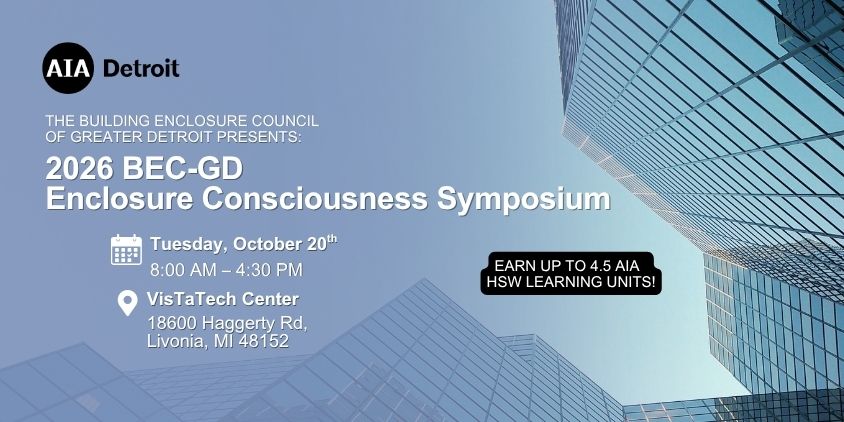
Date: October 20, 2026 | Time: 8:00am - 4:30pm - 4.5 AIA Health, Safety, Welfare (HSW) Credits
2026 BEC-GD Enclosure Consciousness Symposium: Presentations and Speakers
The Building Enclosure Council of Greater Detroit is proud to celebrate its Symposium with you again. Located at the Schoolcraft VisTaTech Center, the BEC-GD Symposium presents a distinguished panel of speakers to discuss the current and upcoming trends in building enclosure performance and evaluation.
The event includes breakfast, lunch, and snacks. As in previous years, there will be Continuing Education Credits and a raffle for prizes for attendees who visit all of the vendors and obtain a signature from each.
AIA Detroit will provide up to 4.5 AIA Health, Safety, and Welfare (HSW) Learning Units.
TICKETS:
Professional Attendee: $50
Student Attendee: $10
AGENDA:
7:45 am – Check-in, American Breakfast, Sponsor Displays
8:45 am – Opening Comments
9:00 am – Presentation 1 – Fiber Cement Wall Panels, by Aaron Rosen
10:00 am – Morning Break, Sponsor Displays & Announcements
10:30 am – Presentation 2 – (1.5 hr) Lessons-Learned from Missing or Undeveloped Masonry Wall Details, by Pat Conway
12:00 pm – Lunch Break, Sponsor Displays & Announcements
1:30 pm – Presentation 3 – The Secrets to Specifying PVC, PVC KEE and KEE, by Jennifer Keegan
2:30 pm – Afternoon Break, Sponsor Displays & Announcements
3:00 pm – Presentation 4 – Good Culture is Cheaper than a Good Lawyer, by Pete Arvant
4:30 pm – Closing Remarks and Door Prizes
PRESENTATIONS & SPEAKERS INFO:
Fiber Cement Wall Panels: The Do’s and Don’ts
Aaron Rosen, PE, RBEC | Principal at RosenBEC
Presentation Description:
Fiber cement wall panels are commonly used as the cladding component of ventilated rainscreen systems, but their performance depends heavily on proper detailing and installation. This presentation examines the building science principles and installation requirements that allow fiber cement panels to accommodate temperature- and moisture-related movement while maintaining long-term performance. Topics include fixed and gliding attachment points, fastener hole sizing and placement, edge spacing, substructure movement, and rainscreen airflow. Real-world forensic case studies illustrate how deviations from manufacturer installation guidelines can lead to panel cracking, bowing, cupping, and other performance issues. The presentation concludes with practical lessons learned for architects, engineers, contractors, and installers to help identify and avoid common installation deficiencies.
Learning Objectives:
• Explain the impact temperature and moisture has on fiber cement exterior wall panels.
• Understand rainscreen airflow and how it properly dries the wall panels.
• Describe the difference between fixed and gliding anchor connection points
• Determine the appropriate location and edge spacing of the anchor connection points.
 Aaron Rosen is a principal at the building enclosure consulting firm RosenBEC. His certifications include Professional Engineer, Registered Building Enclosure Consultant, BECxP, and CxA+BE. He has over 20 years of professional experience working with many different types of cladding systems. Aaron has been retained numerous times to provide a third-party expert opinion on a variety of building enclosure related issues. RosenBEC has been providing building enclosure consulting services on high-end projects across the United States since 2016.
Lessons-Learned from Missing or Undeveloped Masonry Wall Details
Pat Conway, AIA, CSI | Conway Masonry Consulting, LLC with the International Masonry Institute (IMI)
Presentation Description:
An interactive fast-paced look at problems and solutions as it relates to moisture, thermal, and movement control at key interface details within exterior masonry wall assemblies. This seminar will include details for base-of-wall, sills, opening heads, veneer transitions, and top-of-wall. We will talk about both adhered and anchored masonry veneers, flashing, continuous insulation, veneer anchor, parapets, and more.
Learning Objectives:
• Explore how to design and detailing exterior masonry wall assemblies to keep occupants comfortable and safe
• Identify key exterior wall assembly interface details to consider for function, constructability, cost, and aesthetics
• Learn how masonry wall assemblies control moisture, cracks, and energy
• Discover lessons-learned for moisture and crack control from past installation failures and successes
 Pat Conway is an architect with over 30-years’ experience as a masonry consultant for the International Masonry Institute (IMI). He is a distinguished national masonry author and speaker. He is a prolific presenter on masonry wall system topics, including flashing, movement control, high-performance masonry wall systems, air barriers, efficient wall design, structural masonry concepts, masonry drawings and specifications review, modern open-jointed rainscreen veneer systems, creative masonry design, masonry lintels, single-wythe masonry walls, lessons-learned from the job site, and adhered veneers.
The Secrets to Specifying PVC, PVC KEE and KEE
Jennifer Keegan, AIA | Senior Director Building and Roofing Science for GAF
Presentation Description:
Navigating the world of PVC roof membranes can be complex due to two different ASTM specifications (ASTM D 4434 and ASTM D 6754) and variations in membrane composition, particularly those including the KEE plasticizer. When you factor in differences in chemical resistance performance, accelerated aging testing, and overall durability expectations, choosing the right membrane can feel like a real challenge. This presentation is designed to cut through the confusion. It will provide clear definitions and performance insights for PVC, PVC KEE, and KEE membranes. Attendees will leave with precise, actionable specification language to ensure the roofing membrane installed on their project delivers the intended, long-term performance.
Learning Objectives:
• Differentiate between PVC, PVC KEE and KEE membrane types (ASTM D 4434 Type II, III, and IV) and ASTM D 6754) based on composition and properties.
• Explain the critical role of plasticizer in PVC membrane performance, including its effect on long-term performance and chemical resistance
• Compare accelerated aging, chemical resistance and impact resistance results from various membranes to understand the differences.
• Identify performance specification language for use in specifying the best PVC or PVC KEE membrane for a given project.
 As a 25+ year veteran of the building enclosure industry, Jennifer Keegan serves as the Senior Director of Building & Roofing Science for GAF. Her career in building forensics, assessment, design and remediation provided a strong technical foundation for industry collaboration and leadership. Jennifer provides technical leadership within the industry through her involvement with AIA, CSI, and IIBEC; and as an advocate for women within the industry as the Past Chair of National Women in Roofing.
Good Culture is Cheaper than a Good Lawyer
Peter L. Arvant, JD | Chief Risk Officer and Vice President at SME
Presentation Description:
Coming soon!
Learning Objectives:
Coming soon!
 Before joining SME as its first Chief Risk Officer, Pete Arvant spent 30 years in private practice as a commercial litigator with emphasis on design professional and construction disputes, insurance coverage questions, and business conflicts. Those cases took him to hundreds of courtrooms across more than 15 states. His work led to a Super Lawyer® rating by his peers, a designation reserved for the top 10% of lawyers in Michigan. During that time, Pete also served as an Adjunct Professor of Business Law for both the MBA and undergraduate programs at Walsh College. Pete received a Bachelor of Arts degree in Philosophy from the University of Michigan and earned his Juris Doctorate from Michigan State University College of Law.